
9. Compilation and generation
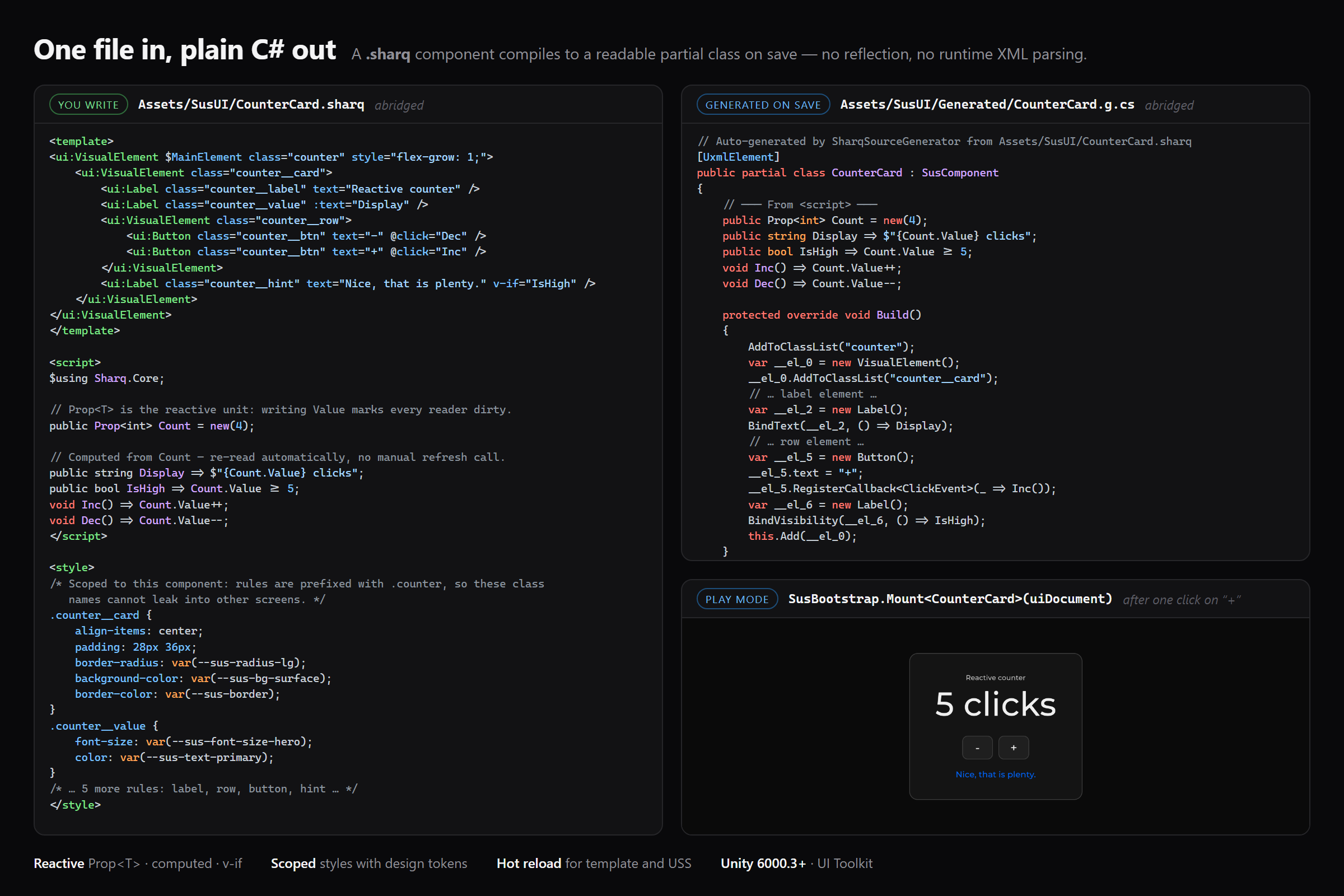
Pipeline
Saving .sharq to Assets/
    │
    ▼ AssetPostprocessor.OnPostprocessAllAssets
    ├── SharqFileImporter.ProcessSharq()
    │   ├── SharqFileParser → SharqFileModel (template, script, style)
    │ ├── SharqSectionCache → incremental regeneration
    │ ├── SharqValidator → diagnostics (warnings)
    │   ├── BuildMethodGenerator → .g.cs
    │   ├── ScopedCssGenerator → _scoped.g.uss
    │   └── StyleParser → .g.uss (global)
    │
    ▼ Result:
        Assets/SusUI/Generated/ComponentName.g.cs
        Assets/SusUI/Generated/ComponentName_scoped.g.uss
        Assets/SusUI/Generated/ComponentName.g.uss (global)
Incremental compilation
- Content-hash: if
.sharqhasn't changed - skipped - Section-level: if only
<style>changed - only.ussis regenerated (hot reload without a C# domain reload) - SharqAutoRegenerate: checks freshness on domain reload
SharqValidator - diagnostics
| Check | Level |
|---|---|
v-for without :key (when StrictVForKey: true) | Warning |
Unused fields in <script> | Info |
Generated files
Assets/SusUI/
├── Component.sharq ← source (you can edit here, in any subfolder)
├── Resources/SusRuntime/ ← author's runtime resources (in git): Icons/, Fonts/, theme-overrides
└── Generated/ ← auto-generated (.gitignored)
    ├── Component.g.cs
    ├── Component_scoped.g.uss
    ├── Component.g.uss
    ├── Component_static.g.uss
    ├── Component.sections.json
    ├── Component.sharq.hash
    ├── .gitignore
    └── Resources/SusRuntime/ ← synced USS components for runtime (auto)
Base theme/icons/fonts (
_theme,_icon,_font,design-tokens) ship inside the package itself:sus-core/Runtime/Resources/SusRuntime/.SusRuntimeis a virtual Resources namespace (Resources.Load("SusRuntime/..")), not "compiler output"; Unity merges everyResources/SusRuntime/folder (package + project) into a single path.
Important: Always edit .sharq, never Generated/* - generated files get overwritten.
Cleanup: deleting a
.sharqfile deletes all 6 generated files, its.meta, and any Resources copies automatically. Renaming deletes the old artifacts and creates new ones.
Loading USS at runtime
Components load styles via Resources/SusRuntime/ (in a build). The Editor has a fallback - if the file isn't found in Resources, it's loaded directly from Generated/ through AssetDatabase.
Batch pipeline (for library packages)
Besides the project-scoped importer (Assets/SusUI), there is a declarative batch pipeline - for libraries that ship already-generated .cs/.uss inside the package itself (optional downstream UI packages).
The package declares WHAT to generate in a descriptor, sharq.gen.json (next to package.json):
{
  "displayName": "My UI Package",
  "sources":   ["Components"],
  "generated": "Runtime/Generated",
  "resources": "Runtime/Resources/SusRuntime",
  "watch": true,
  "namespace": "MyCompany.UI"
}
Optional namespace: a dotted C# identifier wrapped around every generated .g.cs type for that package. Empty / omitted → global namespace (legacy). Downstream UI packages should set this to their package root namespace so short type names don't collide across packages.
Optional usings: a string array of extra C# namespaces emitted as using directives in every generated .g.cs file (when composing types from another UI package).
Optional uss: "resources" writes generated .g.uss only into resources - no copy is kept under generated/. Omitted (default) keeps the previous pair: one .g.uss under generated/ plus an identical copy under resources/. A downstream UI package whose components load styles exclusively via Resources.Load at runtime can use this leaner mode.
Infrastructure lives in sus-core/Editor/Packaging/:
SusPackageRegistry- finds descriptors for all resolved packages; only mutable packages (file:links / embedded) are considered - registry/git packages already ship ready-made artifacts.SusPackageGenerator— menuWindow/SUS/Sharq/Generate All Packages(all packages at once) and windowWindow/SUS/Sharq/Generate Package…(one at a time). Under the hood:SharqBatchCompiler.CompileDirectory(sus-core/Editor/AssetPipeline/), using the sameBuildMethodGeneratoras the importer.SusPackageAutoCompile— a FileSystemWatcher for each source directory of a package withwatch: true(packages outsideAssets/aren't visible to AssetPostprocessor): saving.sharq→ auto-regeneration. In Play mode: style-only / template-only changes useSharqBatchMode.HotReloadSafe(USS + interpreter, without.g.cs/ a domain reload); a<script>change defers until Play mode exits, then runs a full Generate. In Edit mode, it's always a full package Generate.- The result is committed to the package (unlike the project-scoped
Generated/, which is in.gitignore).
Three generation pipelines
| Pipeline | Trigger | Scope | Who |
|---|---|---|---|
| Project | saving .sharq in Assets/ (AssetPostprocessor) + Window → SUS → Sharq → Regenerate All Prototype Components | sus.config.json → SharqDirectory | SharqFileImporter |
| Packages | saving .sharq in the package (watcher) + freshness check on domain reload + menu | all packages with sharq.gen.json | SusPackage* (see above) |
| CLI | manual run / CI | Assets/ without Unity (.g.cs only) | SharqBootstrap |
A package consumer cannot rely on a runtime Roslyn source generator - so
.csis generated ahead of time and shipped in the package like regular scripts.
How the generator translates the author's .sharq into C#
BuildMethodGenerator converts DSL syntax into valid C#:
In .sharq | In .g.cs |
|---|---|
[CreateProperty(default:0)] public Prop<int> Damage = new(0); | [CreateProperty] (the DSL parameters default:/validate: are discarded) plus the backing public Prop<int> Damage = new(0); and a companion property public int damage { get => Damage.Value; set => Damage.Value = value; } |
[CreateProperty] present | auto using Unity.Properties; |
Vue-style quotes in expressions: v-if="Mode.Value != 'delete'", != '' | C# quotes: Mode.Value != "delete", != "" |
$using System.Linq; | using System.Linq; |
using System; and using System.Collections.Generic; are always added.
Conventions for the <script> block
SusComponent : VisualElement- the root is the component itself: usethis.Q<…>(),this.style,this.schedule(notElement.…).- Base lifecycle hooks:
Created(),BeforeMounted(),Mounted(),Updated(),BeforeUnmounted(),Unmounted()(allprotected override void). There is noInit()method - element setup (this.Q<…>(),Watch(...)) belongs inCreated().
Hot reload (Editor + DEVELOPMENT_BUILD)
USS (E1 / E4)
- Editing only
<style>→ regenerates.g.usswithout a domain reload →UssHotReloadServicereloads companion sheets on live components (<1s in Editor Play). - Remote (E4):
SusRuntimeHotReload.ApplyUss+ Runtime MCPui.hotreload.uss/ Session MCPclient.hotreload_uss. StyleSheet-from-text goes via the Editor'sStyleSheetImporterImpl(SusUssFromString). On a standalone player without the Editor factory, USS parsing isn't available; template hot reload still works. - Editor push:
RemoteHotReloadPushService(disable via EditorPrefsSharq.RemoteHotReload.Enabled= 0).
Templates (E3)
- Editing only
<template>→SharqCompileEvents.OnTemplateChanged→TemplateHotReloadService/SharqTemplateInterpreter.TryApply. - Remote:
ui.hotreload.template/client.hotreload_template.
Template interpreter support matrix
| Feature | Status | Behavior |
|---|---|---|
$MainElement / root attrs → this | ✅ | Like BuildMethodGenerator: class / :class / name apply to the host component, children go inside |
class, :class (object), name, :text | ✅ | |
v-if / v-show (literal, !, ==/!=, ||/&&, Prop.Value) | ✅ | Complex C# (string.IsNullOrEmpty, method calls) → fallback |
Prop="lit" / :Prop="expr" | ✅ | Simple strings/numbers/bool/enum |
<slot> / named slot | ✅ | Via GetSlotContainer / BuildSlot |
@click / @* events | ⚠️ skip | Logs [SharqInterp] Skipping unsupported event…; the tree applies without handlers |
transition= on v-if | ⚠️ ignore | The attribute is skipped; the animation only appears after a full recompile |
v-for | ❌ fallback | TryApply → false, needs a domain reload / full Build |
| Arbitrary nested C# expressions | ❌ fallback |
Rule of thumb: simple downstream UI templates (Divider / Badge / a simplified Alert) get TryApply == true; anything notoriously complex (v-for, heavy expressions) predictably falls back with a warning.
State-preserving domain reload (E2b)
When editing <script>, Unity performs a domain reload. To keep the UI from resetting:
- Edit → Preferences → General → Script Changes While Playing = Recompile And Continue Playing (otherwise Play mode stops). Without this preference, Unity stops Play mode on every script change - the snapshot mechanism below is moot.
HotReloadStatePreserveServicesnapshotsSusComponentSnapshotfor UIDocument and EditorWindow Sus-trees before the reload and restores them afterward viadelayCall.- Primitive types plus enum
Prop<T>values are serialized; other types are ignored. - Option in
Assets/sus.config.json:"HotReloadStatePreserve": true(default). Turn it off withfalse.
The "never recompile mid-match" rule still takes priority over a live PvP session - E2b is an Editor convenience, not a replacement for that rule.